Post Archive

Seeking A Technical Collaborator or Successor for the Traceable Heraldic Art

As we approach the fifth anniversary of my Traceable Heraldic Art project, and given how terribly overcommitted I am with numerous projects underway, I wanted to let folks know that if someone with a strong software-development background was interested in developing the next generation of the system that hosts that collection, I’d be open to collaboration and eventually turning it over to someone else to run.

This recent blog post lays out some of the background on how the current system works and what I hope might some day replace it, and links to the source code and data files I use to build and update the site. A successor system might be coded very differently, but I would hope that it would still support the current functionality and enable the development of new capabilities, so it seems likely to be of similar complexity.

This doesn’t mean I am about to abandon the project, but I have spent somewhere about four thousand hours on it already, and would like to free up some time to work on other things. If you’re a combination web-development nerd and armorial-art nerd, and you’re interested in spending years of your life improving and maintaining a much-valued community resource, drop me a line!
An Idiosyncratic System for Publishing the Traceable Heraldic Art

[Note: The below is a lightly-edited revision of an email message I sent to a contributor to the Traceable Heraldic Art collection who asked about the technology used to update the web site. It’s somewhat rambling and may not be of interest to most, but I figured it was worth putting it in the public record. — Mathghamhain]

In hindsight it would have been sensible to tackle the creation of the online Traceable Heraldic Art collection as a web database project, but for historical reasons that’s not at all how it’s architected. Continue reading “An Idiosyncratic System for Publishing the Traceable Heraldic Art”

On Belling the Cat

[Note: this post is not specifically related to heraldry, but I’ve included it here because it is very much concerned with the question of developing web-based tools and addresses issues that frequently arise in the discussion of digital heraldic resources. — Mathghamhain]

Someone recently commented that it was a shame that the SCA didn’t have a tool on its main website that allowed people to enter their zip code and get links to their their closest local branches — instead newcomers need to use a two-step process of using the SCA’s site to find a kingdom based on state, province, or country, then using that kingdom’s search tools to find their local group — surely it would be more welcoming to simplify that process? And might the fact that such an integrated tool doesn’t exist reveal that the SCA doesn’t care about newcomers?

As I responded, I realized that I had written similar comments about a number of other such proposals — frequent topics of this kind of discussion in the context of the College of Arms are building new web tools for Orders of Precedence, or a central registry of all coats of arms — and of course the same issue comes up in numerous other areas — so I figured I’d clip them out and post them here (with just a bit of editing to allow them to make sense on their own) for use the next time this kind of thing comes up.

Continue reading “On Belling the Cat”

Five Years Before The Mast

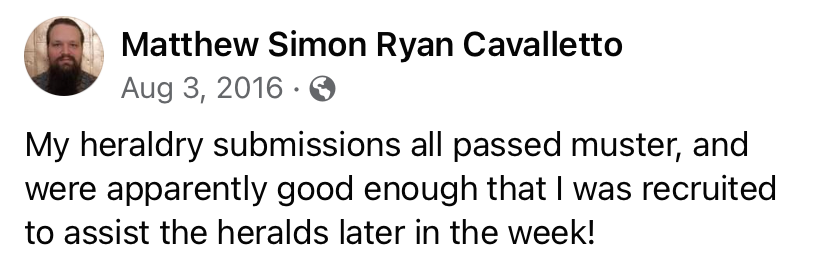
The above social media post marks the five-year anniversary of my having joined the heraldic community.

I had started researching names and device designs for my own submission the previous December, getting some very helpful Irish onomastic advice from Mistress Alys Mackyntoich, and some armory feedback from the Facebook Heraldry Chat group.

I spoke to the former heralds of my canton and province that spring, but they weren’t submissions experts, so rather than mailing in the forms I filled them out as best I could and brought them to the Heralds Point tent at Pennsic that summer.

By happenchance, the herald who I was routed to was Meisterin Gisela vom Kreuzbach, who looked over the large pile of poorly-summarized documentation I had handed her and decided nonetheless that I had some promise, and invited me to come around the desk to sit by her and watch over her shoulder as she entered the records into the forms interface. I wound up shadowing her through several consultations that afternoon and returning for more a couple of days later, and by the end of the week I was hooked.

Little did I know that moment would set me on a path to spending literally thousands of hours working on this esoteric corner of our peculiar hobby. Thank you to everyone who has given me a hand up over the last five years, and to the many who went before us and paved the way for the world we now inhabit.

Traceable Additions for May

Another two hundred and forty illustrations have been added to the Book of Traceable Heraldic Art during the last six weeks.

I’m not much of artist, relying on others to share their illustrations, so I’m very pleased to welcome Alessandra Sartor as a new contributor, and give thanks to the continuing efforts of Iago ab Adam, Jessimond of Emerickeskepe, Saewynn aet Cnolle, Forveleth Dunde, Elionora inghean Ui Cheallaigh, Malys mac Néill, Zubeydah al-Badawiyyah, and Estelle de la Mer.

Continue reading “Traceable Additions for May”

Tracing Heraldic Art in Clip Studio

In this video class for Ansteorra King’s College, Lady Elionora inghen Ui Cheallaigh provides an in-depth tutorial on tracing examples of armory from scans or photographs to produce digital images which can be used by the reenactment community.

The primary application used here is Clip Studio (Windows/Mac, $50) but the techniques are generally applicable to most other modern digital illustration software. There’s also some brief discussion of related tools, including how to convert images to vector art and assemble complete devices in Inkscape.

Examples of some of the other art that Lady Elionora has traced can be found on her artist’s page at the Traceable Art site.

A Revised Armory Conflict-Checking Checklist

[Editor’s Note: This is a revised version of a checklist I assembled in 2019, which was rendered out-of-date by the new rules for considering changes to the field approved by the March 2021 Cover Letter. This updated version of the document reflects those changes. — Mathghamhain]

SENA devotes over 10,000 words to conflict checking armory, which the below guide attempts to summarize in one-twentieth of the space.

Many details have been omitted, so references are included to the relevant sections of SENA to facilitate additional research as needed. Continue reading “A Revised Armory Conflict-Checking Checklist”

An Updated Map of Østgarðr

Back in 2017, I put together a map of the Crown Province of Østgarðr and its cantons, as well as our neighboring shires and baronies.

Over the winter I updated the map to reflect a few changes in status the have accumulated in the intervening years — the Incipient Shire of Nordfjord has been promoted to the Shire of Old Stonebridges, while the Canton of Northpass and the Shire of Frosted Hills have been dissolved — but I forgot to post the new version to this site, which error I’m now rectifying.

(Click the map for a much-larger version.)

How the East Kingdom got its Blue Tyger

The Blue Tyger (sometimes informally known as “Sparky”) serves as a sort of mascot for the East Kingdom, appearing in its populace badge as well as many of its award insignia.

Earlier this year I got curious about why this was, and asked some Eastern heralds, who provided a bunch of the context: the blue tyger had been selected by Alfgar the Sententious, first Brigantia Herald, as a figure from East-Asian mythology and a riff on the dragon of the Middle Kingdom.

Continue reading “How the East Kingdom got its Blue Tyger”

[People’s Democratic Republic of the East, Returned, Apr 1996 LoAR]

I recently stumbled across this gem in the Archive of Laurel Letters:

Laurelin Hardy Letter of Intent of 1 April 1996

East, People’s Democratic Kingdom of the. Name and device. Purpure, in saltire a hammer and sickle within a laurel wreath, in chief a crown Or.

Continue reading “[People’s Democratic Republic of the East, Returned, Apr 1996 LoAR]”