Post Archive

Orders and Awards of Østgarđr and the East Kingdom

Following a recent discussion of kingdom and provincial orders and awards, I thought I’d try my hand and putting together a visual overview, in part to force myself to wrap my head around all of them, and also in hopes that the result might be of use to others.

My point of reference for this was the East Kingdom Awards Overview created by Tola knitýr, which is itself based on a similar chart created for the Middle Kingdom by Gebhard.

Rather than just copying the existing chart, I wanted to make sure I understood the underlying awards, but after looking at various write-ups online, it turned out that many of them were out-of-date following a significant reorganization of the East Kingdom award structure that took effect in October 2015.

Continue reading “Orders and Awards of Østgarđr and the East Kingdom”
Every Distinct Tincture, Fur, and Field Treatment

A discussion earlier this year led me to the calculation that there were 97 heraldically distinct tinctures, furs, and field treatments recognized in the SCA, and this evening I figured I’d go ahead and sketch them all out.

The math works out as follows:

  • 7 solid tinctures (2 metals plus 5 colors) +
  • 10 neutral furs (every combination of 2 metals x 5 colors) +
  • 20 ermine furs (2 metals ermined of 5 colors each, plus 5 colors ermined of 2 metals each) +
  • 20 masoned (2 metals masoned of 5 colors each, plus 5 colors masoned of 2 metals each) +
  • 20 papellony (2 metals papellony of 5 colors each, plus 5 colors papellony of 2 metals each) +
  • 20 scaly (2 metals scaly of 5 colors each, plus 5 colors scaly of 2 metals each).
Continue reading “Every Distinct Tincture, Fur, and Field Treatment”

Examples of Individually Attested Pattern Registrations

[Update, December 2020:] For the latest version of this document, see A Catalog of Individually Attested Pattern Submissions which includes additional items not listed below.

The SCA’s current rulebook for heraldic submissions, The Standards for Evaluation of Names and Armory (or SENA), establishes a common set of requirements called the “Core Style,” based on armorial practices that were common across late-medieval Europe and on Anglo-Norman conventions in particular.

However, it also provides an escape hatch — you can register designs which do not meet the core style rules if you can show that all of their elements were part of established heraldic practice in some particular time and place. This mechanism is known as an “Individually Attested Pattern” (or IAP), and allows for registration of designs which are typical of German, or Italian, or Japanese, or other heraldic cultures but which would not be registrable under the Anglo-Norman-influenced core style rules. Continue reading “Examples of Individually Attested Pattern Registrations”

Traceable Art at Pennsic

The Book of Traceable Heraldic Art made its premier appearance at Pennsic’s Heralds’ Point art tent this year.

I brought printouts of the full thousand-plus page collection with me, which was sleeved into page protectors by the volunteers at the point. While the new collection is not yet complete enough to retire the old Pennsic Traceable Art book, I was pleased to see that it was of practical use for many of the hundreds of armory submissions generated this year.

Throughout the week of activity, the team in the art tent generated useful notes about areas that needed more work, and as the Point was closing up, Signora Beatrice Domenici della Campana and Master Kryss Kostarev took several hours of their time to sit with me and systematically work through the first 430 pages identifying designs which needed correction or could be safely omitted from the version to be used on site next year.

I look forward to incorporating that feedback and continuing to expand the collection over the coming year.

Names and Arms for Sara and Giuseppe Sala di Paruta

Sara and Giuseppe live in our neighboring barony of Dragonship Haven. Her name and arms had been registered but she wanted to tweak them, while his were being registered for the first time.


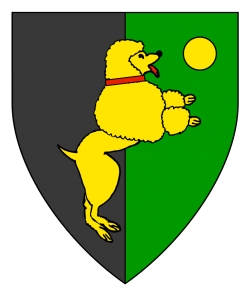
Per pale sable and vert, a poodle salient contourny Or, collared and langued gules, and in sinister canton a bezant.

Sara already had similar arms registered, but with a talbot sejant, which she wanted to swap for a poodle salient.

Poodles are documented as period, being known from at least the fifteenth century. The poodle illustration is adapted from the submissions of Briana Heron of Caid, using the period shearing for water dogs without ornamental pompoms.

Continue reading “Names and Arms for Sara and Giuseppe Sala di Paruta”

Name and Arms for Lady Angelica di Nova Lipa

Lady Angelica is an established member of the society, serving as the chatelaine of the Canton of Whyt Whey, but had never registered her name or arms, an oversight I was pleased to help correct.


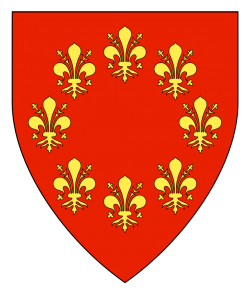
Gules, eight fleurs de lys in annulo Or.

In our first round of consultation, Angelica identified red and gold as her preferred colors, and the Florentine fleur de lys as her desired primary charge, but pinning down the optimum arrangement required multiple iterations before this design emerged as the favorite.

Continue reading “Name and Arms for Lady Angelica di Nova Lipa”

Intellectual Property Rights In Branch Armory

An interesting point came up as part of the recent discussion of copyright and armorial registrations: what rights does the SCA as an institution have with regards to the images and designs used in devices and branches?

The question was triggered by an element of the Society’s rules found in section XII of the SCA’s “Corporate Policies” document, which is inexplicably difficult to locate online, but which can be found in a revision markup for changes made in 2013.

Continue reading “Intellectual Property Rights In Branch Armory”

Copying Heraldic Art from OSCAR

I recently asked a group of heralds what the conventions were on copying heraldic art from OSCAR for re-use in other submissions, and thought it would be useful to write up some notes on the subject here for future reference.

Copying elements from previous submissions to use as clip art when creating new armory is not uncommon. While some heralds are great freehand illustrators, others are not (myself included), and being able to pull charges from an existing image and repurpose them allows those folks to assemble good-looking submissions for the registrants they are assisting.

Continue reading “Copying Heraldic Art from OSCAR”

Badge for Lady Beatrice della Rocca

Lady Beatrice selected her badge in consultation with Erich Gutermuth, the deputy herald for Whyt Whey, and I was pleased to be able to assist them with the registration process.


A roundel counter-vair.

This design raised an interesting corner case where two of the SCA’s heraldic rules intersect:

Firstly, longstanding precedent holds that you can’t register a fieldless badge consisting of a shape which is a standard form for heraldic display, such as an escutcheon, billet, or roundel. The reason for this rule is that allowing such registrations would create the possibility for confusion; for example, when viewing a black and white square, one might wonder “is this a delf per pale sable and argent, or is it simple per pale sable and argent displayed on a rectangular object?”

Continue reading “Badge for Lady Beatrice della Rocca”

A Geographic History Of The East Kingdom

In AS XXIV (early 1990), Lord Richard the Poor assembled a collection of maps setting forth the growth and evolution of the SCA branches that make up the East Kingdom. Covering two decades, the maps provide a visual reference for the kingdom’s growth from a few isolated groups in New York and Boston to dozens of baronies, cantons, and shires covering the region.

Originally hand-drawn and typeset in the days of dot-matrix printers, the book had fallen out of circulation with only a single copy available online, on the Æthelmark history web site. With Lord Richard’s permission, I am making the original work available for download here (45 MB PDF) and have converted it to a more web-accessible form.